Sponsor Me!
In these mad times we find ourselves in people with mental health problems have never been more in need of help, and with the NHS’ services at breaking point it’s charities like Dare 2 Express that try to fill in the gaps and give people the support they need. That’s why I’m trying to raise money for Dare 2 Express, and you can sponsor me using my Just Giving page.
Your donation could literally save someone’s life!
Week 11
Day 47
Day 47 and day 17 of my January challenge. 9 miles, split into two runs, the second after I’d had a few beers in the afternoon, which wasn’t the best idea I’ve ever had. The miles were run though and another day completed.
Today took me through the lovely town of Pitlochry – somewhere we visited a number of times while on holiday last year – crossing the River Tummel using the iron suspension bridge (opened by the Marchioness of Tullibardine on Empire Day 1913, was built to replace the Port na Craig ferry which had crossed the river since the 12th century). The bridge was bouncy enough when we walked across it so god knows what it would have been like if I’d actually run across it!
From there the route followed the River Tummel dowb to the A827 near Logierait before following a nice quiet lane, following the River Tay this time.
Route
[sgpx gpx=”/wp-content/uploads/gpx/virtual-jogle-day-47.gpx”]
Route Video
Below you can see a video of the route, showing Google Street View images from along the route.

Photos
Some photos from my virtual run.


Day 48
Day 48 and day 18 of my January challenge. Almost up to the 10 mile a day mark – that’ll be tomorrow! – but today’s 9 1/2 miles wasn’t too difficult, splitting into lunchtime and after work runs.
The route for today saw me following the River Tay down to Birnam, passing Kincraige, Dalguise, and Little Dunkeld on the way.
Most of the day’s miles were on nice quiet lanes but yet again I found myself picking up the A9 for a couple of niles before picking up the B867 the other side of Birnam.
John Everett Millais, who painted many local landscapes, and Beatrix Potter, with her family, often visited Birnam. Potter drafted her first book, The Tale of Peter Rabbit, at Eastwood House whilst writing a story and picture letter to child friend Noel Moore on 4 September 1893. There is an exhibition and garden dedicated to Potter and her characters in Birnam.
There is an ancient tree, the Birnam Oak, standing a few hundred metres from the centre of Birnam on Murthly Estate. Traditionally, it was known as “The Hangman’s Tree”. The Birnam Oak is believed to be the only remaining tree from the Birnam Wood of Macbeth.
Route
[sgpx gpx=”/wp-content/uploads/gpx/virtual-jogle-day-48.gpx”]
Route Video
Below you can see a video of the route, showing Google Street View images from along the route.

Photos
Some photos from my virtual run.


Day 49
Day 49 and day 19 of my January challenge, and more importantly the first of my double digit days – eeek!
Today’s route started off along the B867, passing Waterloo and Bankfoot, before following the A9 again down to the outskirts of Perth, passing Luncarty along the way. After the A9 I picked up a footpath following the River Tay again for a little bit.
Local opinion is divided on the origin of the name Waterloo. Most agree that the hamlet was named after the Battle of Waterloo. However, some say it was named Waterloo because it was settled by soldiers returning from the battle, while others assert that it was given the name because the hamlet was built for the widows of the soldiers who did not return from the battle.
Just outside Waterloo there are two standing stones known as the Staredam standing stones. The stone on the right-hand side (if you’re facing the stones from the road) has a cross carved in it and is suggested to be one of the earliest examples of Christian symbology being carved on pre-historic standing stones.
The present village of Luncarty was founded in 1752 by William Sandeman, to house workers at his bleachfields. William and his partner Hector Turnbull manufactured linen in Perth and bleached it in Luncarty. In 1752 he leveled 12 acres (5 hectares) of land in Luncarty to form bleachfields. By 1790 when William died, the Luncarty bleachfields covered 80 acres (32 hectares) and processed 500,000 yards (460,000 metres) of cloth annually. Second only to agriculture, linen manufacture was a major Scottish industry in the late 18th century — linen then became less important with the introduction of cotton
I’m pleased to report that the 10 miles for today went really well. I did 5 miles at lunchtime and 5 miles after work, both of which weren’t too much of a bother, and my legs – so far – are holding up well.
Route
[sgpx gpx=”/wp-content/uploads/gpx/virtual-jogle-day-49.gpx”]
Route Video
Below you can see a video of the route, showing Google Street View images from along the route.

Photos
Some photos from my virtual run.


Day 50
Day 50 and day 20 of my January challenge, and carrying on in the double-digit miles, which so far aren’t going too badly, especially as I’m being sensible and not trying to do the miles all in one go.
A nice start to today’s run, following the River Tay on the outskirts of Perth before picking up the A912 to Bridge of Earn and Kintillo.
Once through Kintillo I picked up a quiet country lane for the rest of the day’s miles.
Bridge of Earn, often referred to simply as ‘The Brig’ (Scots for ‘bridge’), grew up on the south bank of an important crossing of the River Earn, whose sandstone bridge existed from at least the early 14th century, when it is known to have been repaired by order of King Robert I of Scotland (1306–1329). Substantial remains of the medieval bridge (rendered redundant by a replacement, still in use, slightly upstream in 1821-22) survived into the 1970s, when almost all the stonework was demolished, for (allegedly) being in a dangerously ruinous condition.
Claiming to be the oldest village in Scotland, Kintillo with its neat thatched 18th-century cottages has now been largely subsumed as a southern suburb of Bridge of Earn.
Route
[sgpx gpx=”/wp-content/uploads/gpx/virtual-jogle-day-50.gpx”]
Route Video
Below you can see a video of the route, showing Google Street View images from along the route.

Photos
Some photos from my virtual run.


Day 51
Day 51 and day 21 of my January challenge. I won’t lie; the longer days are definitely taking their toll on me. Even splitting the miles is tiring me out. I’m determined to reach the end of this month’s challenge though.
I guess there’s one bonus for doing the longer miles? I’m getting to the Scottish/English border a bit quicker than I would have done if I’d not taken on this mad January challenge?!
Today’s route had me following the M90 but on A roads, taking me through Glenfarg, Duncrievie, Drunzie, Milnathort and Kinross (passing Loch Leven), before finishing a little bit past Gairney Bank.
Loch Leven Castle is a ruined castle on an island in Loch Leven. Possibly built around 1300, the castle was the location of military action during the Wars of Scottish Independence (1296–1357). In the latter part of the 14th century, the castle was granted by his uncle to William Douglas, 1st Earl of Douglas, and remained in the Douglases’ hands for the next 300 years.
Mary, Queen of Scots was imprisoned in the castle in 1567–68, and forced to abdicate as queen, before escaping with the help of her gaoler’s family. In 1588, the Queen’s gaoler inherited the title Earl of Morton, and moved away from the castle. It was bought, in 1675, by Sir William Bruce, who used the castle as a focal point in his garden; it was never again used as a residence.
Only another 10 days of my month’s challenge, and to be honest, I can’t wait to get back to the sensible average of 5 or 6 miles a day!
Route
[sgpx gpx=”/wp-content/uploads/gpx/virtual-jogle-day-51.gpx”]
Route Video
Below you can see a video of the route, showing Google Street View images from along the route.

Photos
Some photos from my virtual run.


Day 52
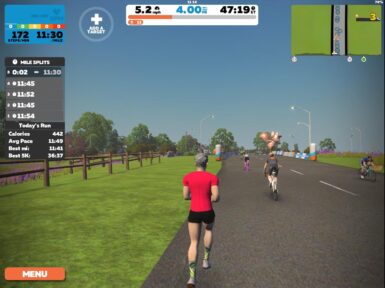
Day 52 and day 22 of my January challenge and 11.5 miles completed on the treadmill. Boy I’m spending a lot of time in the garage doing this!
Today’s miles took me past Kelty, through Cowdenbeath and Crossgates, finally ending up Inverkeithing, not too far away from the Forth Bridge, which is nuts!
The earliest indication of human activity in the immediate vicinity of the current site of Cowdenbeath was provided by the discovery of late Bronze Age vessels containing incinerated human remains, in 1928. An article by eminent archaeologist A.D. Lacaille F.S.A Scot details the find of a late bronze-age cemetery near Tollie Hill. One of the urns found contained fragments of processed Arran pitchstone, indicating some economic activity and commerce.
It is alleged that the infamous graverobbers Burke and Hare sourced some of their cadavers from Beath Cemetery, to supply to the Scottish surgeon Robert Knox for dissection. Precautions were taken at Beath Cemetery to prevent body-snatching and for many years what were taken to be two iron coffins without lids dug up from the old churchyard lay near the old hearse house. These were not actually coffins, but old-time safes that were placed over the coffin to hinder the work of the body-snatchers.
Another preventative measure adopted was the placing of a large flat stone on top of the grave. This stone was very heavy and was placed on the grave and removed by means of a trestle hoist, the rope going through the stone and fastened on the underside, and it remained there until the danger of “snatching” was past. The two “safes” have since disappeared, but the flat stone is still to be seen near the church.
Inverkeithing was given royal burgh status during the reign of Malcolm IV in the 12th century.
Route
[sgpx gpx=”/wp-content/uploads/gpx/virtual-jogle-day-52.gpx”]
Route Video
Below you can see a video of the route, showing Google Street View images from along the route.

Photos
Some photos from my virtual run.


Day 53
Day 53 and day 23 of my January challenge, and things are getting serious now. 12 miles today which is only going to get bigger over the next 8 days!
Shortly after starting today’s miles, the route took me across Forth Road Bridge and then hanging a right away from Edinburgh at Newbridge. From there I headed past Broxburn, finishing the day’s miles in Livingston.
The Forth Road Bridge opened in 1964 and at the time was the longest suspension bridge in the world outside the United States. The bridge spans the Firth of Forth, connecting Edinburgh, at South Queensferry, to Fife, at North Queensferry. It replaced a centuries-old ferry service to carry vehicular traffic, cyclists and pedestrians across the Forth.
The village that later became Broxburn probably originated around 1350 when Margery le Cheyne inherited the eastern half of the Barony of Strathbrock (Easter Strathbrock) on the death of her father, Sir Reginald le Cheyne III. The hamlet that grew up around her residence was then called Eastertoun (eastern town) after the land on which it stood.
Easter Strathbrock was burned to the ground sometime in 1443-4 during a conflict between William, Earl of Douglas, Lieutenant-General of Scotland, and William, Lord Crichton, Chancellor of Scotland. It was destroyed again in 1455 during fighting between the Douglases and King James II. After the conflict, peace was regained and the town was gradually resettled.
The village was renamed Broxburn in 1600 by Sir Richard Cockburn of Clerkington, Keeper of the Privy Seal of Scotland, almost certainly after Broxburn, East Lothian.
Under the New Towns Act of 1946 and in part to ease overcrowding in Glasgow, Livingston was designated as a New Town on 16 April 1962. Livingston was the fourth new town of five in Scotland; the others were East Kilbride, Glenrothes, Cumbernauld and Irvine. Three villages (Livingston Village and Livingston Station in the old parish of Livingston and Bellsquarry in the parish of Mid Calder) and numerous farmsteads were incorporated into the Livingston new town.
Route
[sgpx gpx=”/wp-content/uploads/gpx/virtual-jogle-day-53.gpx”]
Route Video
Below you can see a video of the route, showing Google Street View images from along the route.

Photos
Some photos from my virtual run.